


IV. THE BACK AND FRONT PALM
It will probably never be settled satisfactorily to whom should go the credit for the invention of the back and front palm with cards, but it is generally accepted that the same principles with regard to coins were invented by T. Nelson Downs. Briefly the back and front palm consists in making a coin pass from the front to the back of the hand, and vice versa, in such a way as to be able to show both sides of the hand empty in succession.
The writer of Mr. Downs’ book Modern Coin Manipulation gave a detailed description which purported to be an explanation of the method used by Mr. Downs. Briefly stated, the reader is told to hold the coin on the fingers at the first joints; grip its sides with the first and fourth fingers; make it revolve to the back, the hand being held palm outwards; pinch it between the first and second fingers, with the other two fingers spread wide apart; grip it between the second and third fingers, spreading the first and fourth fingers; pinch it between the third and fourth fingers, spreading the first and second; then repeat all these movements in the reverse order before finally placing the coin in the oblique palm.
As a matter of fact, these gymnastic finger exercises were never used by Mr. Downs in his public performances, not even the revolution from the front finger hold to the rear finger hold. The fact, of course, is that even if the moves could be done so perfectly that the spectators could get no glimpse of the coin at any time their very execution would simply telegraph to the most stupid onlooker exactly where the coin was at any given moment. Mr. Downs was too great an artist to do that. He used the back and front palm only incidentally and in a natural way to prove, apparently, that the hand was empty on both sides, the coin having vanished into thin air.
Unfortunately, because of the large sale of the book and the great reputation achieved by Mr. Downs, this so-called explanation of the sleight has done great harm, not only by putting a stumbling block in the path of beginners, but by the attempted performance of the moves in public by performers who ought to know better. The two methods which follow are entirely practical and are not difficult. No others are necessary.
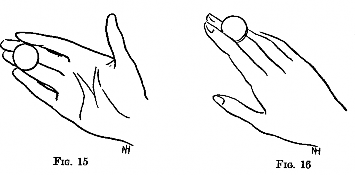
1st Method. Stand with your left side to the audience, the right arm stretched out to the right, palm outwards, the thumb pointing upwards, the fingers extended and joined, the coin in full view against the top joints of the two middle fingers, and the sides of the first and fourth fingers pressing lightly on the edge of the coin (Fig. 15).
Under cover of a pretended throw upwards bend the tips of the middle fingers under the coin, making it revolve to the rear, and pinch its upper edge between the top joints of the first and second fingers. Do not separate the third and fourth fingers; merely bend them a trifle inwards. The front of the hand is thus shown empty (Fig. 16).
To show the back of the hand, begin to close the fingers at the first joints only—that is, keeping them extended—and turn the hand and the wrist without moving the arm. When the back of the hand is toward the spectators, in an almost vertical position, place the tip of the thumb on the edge of the coin and pull it into the front pinch. Stretch the fingers out again and show the back of the hand. Both sides of the hand have thus been shown empty.
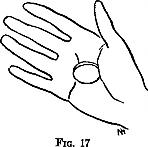
2d Method. Proceed exactly as in the first method up to the point where the hand is held palm outwards with the coin at the back, pinched between the first and second fingers. Bend the fingers and turn the hand and wrist as explained; pass the third finger, stretched out, above the coin, pinching it between the second and third fingers; bend these two fingers into the palm and press the coin into the oblique palm; then stretch out the four fingers and the thumb, separating them widely (Fig. 17). The whole movement can be executed—so rapidly that the spectators do not realize that the fingers have left their sight for a moment.
To show the palm empty again, bend the fingers as before and pinch the coin between the second and third fingers; stretch them out; place the tip of the first finger on the edge of the coin and hold it pinched between the first and second fingers at the back. The transfer is made with the back of the hand toward the audience, the hand itself being motionless. At this moment turn the hand to the front with the fingers stretched out and joined, thus showing the front of the hand empty with the coin back at the starting point. The whole action can be done in a flash and is quite illusory.
These transfers, in common with all the other sleights, must be executed under cover of natural gestures, purely as a means to an end and not as exhibitions of digital dexterity.
Website Content: © Copyright 2024 by Trickshop.com.