

2. THE TOURNIQUET
This vanish, which has been used by generations of magicians, is still one of the best when skillfully done.
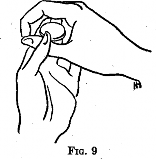
Show the coin in the left hand, for example, held flat between the tips of the thumb and the second and third fingers. Bring the right hand over, palm downwards, pass the thumb well under the coin (Fig. 9) and close the fingers from above. At the moment that the coin is hidden by the right fingers, relax the grip of the thumb and let the coin fall. It strikes against the right thumb, turns vertically, and lands in the finger-palm position in the left hand, where a very slight contraction of the two middle fingers holds it securely. At the same moment close the fingers of the right hand completely, apparently seizing the coin, and move that hand upwards to the right in a diagonal direction. Turn the left hand over a little and point to the right hand with the forefinger, at the same time making a turn of the body toward the right. Complete the vanish as described above.
I cannot emphasize too strongly the fact that sleights must not be regarded as tricks; they are simply devices to be used secretly in the execution of tricks, of which the spectators should not have the slightest suspicion. In this case, after having shown the coin in the left hand, turn your attention to the spectators and, in the course of your patter, execute the sleight casually, without looking at your hands, and turn your eyes on the hand supposed to hold the coin only after you have raised it to about shoulder height. You may then open the hand a little, keeping its back to the front so that the spectators cannot see into it, and say something about a peculiar mark on it and even pretend to turn it over with the other hand. The whole idea is to convince the audience that the coin is actually in the hand which is supposed to hold it. If you succeed in doing this, then the resulting vanish becomes a real feat of magic; anything short of this is failure. This is the reason that so many performers who execute the mechanical part of these sleights fail in the presentation of the tricks in which the sleights are used. They emphasize the sleights instead of the trick and completely overlook the fact that it takes misdirection and presentation in addition to the sleights to make any trick really illusive.
Naturally the movements required in making the sleights must be carefully studied and practiced until they can be done perfectly, but in the final analysis it is the presentation and misdirection which are the principal parts of the trick itself. It would be impossible to treat these points fully in connection with each sleight. Every performer must work them out for himself. Time spent in this way will bring a much greater reward than hours wasted on learning complicated maneuvers.
Website Content: © Copyright 2024 by Trickshop.com.